Friday, 1 May 2020

May Day


There is a fine and well-tuned chorus of spring peepers this evening, in full throat for the first time this spring. Earlier, as they were warming up, they provided a back-up for a robin’s triumphant solo with all the grace notes and considerable volume. I was out on the porch a short while ago (9:00 pm ish) and the sky was still blue well after sunset and a bright star (probably a planet, in truth) had been hung in the branches of the oak tree. May 1st, and, yes, spring. Finally.

Lots of buds
In fact, my daffodils are finally deciding that they are going to bloom after all. We had a day yesterday of soft rain and the back field turned green and the tight, cold-rejecting buds in my bulb bed began to take notice. Today a lot of the minis are in bloom and the whole bed begins to look promising.

The oak tree is now the only tree in what I think of as the front of our house, even if the front door is on the other side. Very close to the screen porch there was a large and somewhat decrepit black cherry and in front of that a clump of birch that had never really recovered after the ice storm. To get the cherry to fall away from the house, JG had to cut the birch away. So, down it came, and the cherry followed. Poor guy has just finished raking up all the dead crunchy stuff that broke off when it was felled, but it did land exactly where he had planned for it to go. He hauled the trunk away while there was still snow on frozen ground and cut it up. Today he split some of it and remarked that there was a lot of rot in the lower trunk. Good thing he got it down. But it does change the view from the screen porch.


The two stumps, one centre and one just showing to the right of the oak trunk are the new cuts.
 Word Nanny wants me to put a comma after ‘But’ in the sentence above, but I am not going to do it. That is how I write and I WANT that to be two sentences. Word Nanny is just about as unreasonable as my Grade 13 English teacher sometimes. If I want to be colloquial, it is for a reason. Damn it! And I will swear if I want to. This is a blog, not an erudite essay. I still recall that teacher with a mixture of horror and amusement. Her name was McIntosh. We had Macbeth as our Shakespearean play and the woman hung a wooden knife from a light fixture when she read us the ‘Is that a dagger …” speech. Honest. She did. Ever after, we referred to her as Mac the Knife.

Um, where was I? Oh yes, May, spring, flowers and song. There will be a half moon along before very long. We have a small flock of turkeys wandering in and out of the back field, mostly to check out the feeding station to see if the deer left then any corn. The male is hopefully displaying and pacing and the females are paying him absolutely no attention whatsoever. Poor guy.

I took out the corn and deer ration to the feeding rock this afternoon and there was a doe who just stood close by and watched me set up the piles. As soon as I stepped away, four more, all does, simply materialized out of the bush. I had made five piles. Three deer trotted up and started eating. The fourth ignored her pile and chased the smallest of the five away from the rock. Mean. The deer are not quite as horrid to one another as the hummingbirds, but the fully adult does can be pretty ugly to the smaller ones.

I have to rummage through the storage room and find the hummer feeders asap. There is forsythia out in Perth, I am told, so the hummers will be along. No trillium yet. One mosquito in the kitchen at supper time. Ah, spring.

Wednesday, 22 April 2020

Hey, you up there on the snow cloud.


MEMO
TO:         Weather Gods
FROM:  MPG
RE:          Overnight Snow
DATE:    April 22

Please note date above.
As of this date, no more snow is required. Please send warm and gentle rain instead. Sunshine would be good also, but that may be beyond your capacity at present.
Propitiation will continue as burnt offerings in the woodstove until further notice. Weather dances are cancelled for the present due to cold-aggravated arthritis.
Thank you for your prompt attention to this matter.

Tuesday, 14 April 2020

Faking it.


The lock-up affects us all in different ways.

In a moment of madness I went looking for face  mask patterns through Google search and found several. My helpful husband also found and printed off one for me to use. I dug into boxes of craft materials that I have not accessed since the grand girl got too old to come out here and make things while we looked after her for her parents (she was putting in her own zippers by her last visit). I have piles of suitable fabric and filter material. I looked for and found an incredible assortment of sizes of elastic. And got at it, yesterday.

Needless to say, the first try was an abject failure. I used the pattern JG found
and it turned out to be way too big and too loose. I am now about to embark on a second that strikes me as being a bit small, but we will see. Goodness knows I have lots of stuff to keep at it until I get one that actually works. In the meantime, a Facebook friend who is an incredibly talented seamstress has made one mask (that she posted about anyway) that not only works and fits but has a matched pattern on it. Oh, well.

More on this topic later. Maybe. For non-sewers, I promise to warn you.

My other preoccupation has been, of course, news. On the internet, on the radio, in our two daily papers. Quite a bit of it is very confusing. Quite a bit of it is bad for my blood pressure. Some of it made me cry. And I made a most embarrassing discovery about a mistake I have been making for quite some time.

I have this prejudice about the meaning of words. I like them to be used the way I think is accurate. I can work myself up to a really good grumble when someone uses ‘decimate’ to mean a high but indeterminate number of deaths. You see, I was a Roman era scholar back in the day and learned that ‘decimate’ means ‘destroy one in ten’, * I know that the meaning has broadened, but that doesn’t mean I have to like it.
* Definition of decimate (transitive verb)
1: to select by lot and kill every tenth man of, decimate a regiment
2: to exact a tax of 10 percent from
3a: to reduce drastically especially in number. cholera decimated the population
The connection between decimate and the number ten harks back to a brutal practice of the army of ancient Rome. A unit that was guilty of a severe crime (such as mutiny) was punished by selecting and executing one-tenth of its soldiers, thereby scaring the remaining nine-tenths into obedience.
It's no surprise that the word for this practice came from Latin decem, meaning "ten." From this root we also get our word decimal and the name of the month of December, originally the tenth month of the calendar before the second king of Rome decided to add January and February. In its extended uses decimate strayed from its "tenth" meaning and nowadays refers to the act of destroying or hurting something in great numbers.

Decimation by William Hogarth Beavers, Roman Military Punishments, Chapter 4 (Wikipedia)

Um, I was going somewhere before I got diverted into Merriam-Webster. Oh yes. It finally percolated through my thick skull that the modern world is using ‘fake news’ not to mean something that is made up rather than real but to indicate something that is exaggerated by the press beyond its neutral news value. Not as in ‘fake it till you make it’. Back to Google.**

** adjective: fake, not genuine; counterfeit.
Similar: forgery, counterfeit, copy, sham’ fraudulent
(of a person) claiming to be something that one is not, "a fake doctor"

There are even several definitions*** of ‘fake news’ that could have clued me in earlier if I had not been so arrogant.
*** Fake news is written and published usually with the intent to mislead in order to damage an agency, entity, or person, and/or gain financially or politically, often using sensationalist, dishonest, or outright fabricated headlines to increase readership, (Wikipedia)

Words that ‘stray from their original meaning’. Little lost sheep, Bah, humbug. I feel obliged to take a different look at what President Trump has been trumpeting about, much as I would rather scrub toilets.
It is so easy to misread someone’s comments when a word is not being used in the same sense by both parties. I recall pleading with my junior high school students to regard language as a tool and realize that the sharper the tool, the better the result. I have not long since been hammering at my ESL students to try to get them to understand that there is a difference between the simple tenses and the progressive tenses. (‘I eat my breakfast at 8:00’ am vs ‘I am eating my breakfast’) My father was a lawyer, my mother a life-long student and teacher of English. They used to argue about language, my mother accusing my father of obfuscation in some legal document he had written and my father complaining that Shakespeare was not poetry because it did not rhyme. (Not hard to see why I turned out the way I am, eh.) And misreading plays hob with cooperation and fellowship.

To top it all off, of the patterns I found that made sense to me, only one mentions seam allowance width and it is not clear whether you are to cut it outside the provided pattern or not. I am going to have a lot of masks of wildly variegated sizes before I get one right, I can tell. Ah well, I do have a lot of time to spend on this project.

Thursday, 2 April 2020

A Distanced Diary


This is a very dull set of sort-of diary entries. I am going to make it more fun, for me anyway, by adding, quite randomly, some photos that I like.

Saturday

It is a grey sort of day, cool cloudy and still. It is not melting the tired old snow and ice. It is not enticing me to go out and walk. But when I was out, I could hear a robin, cheerful soul that he is, happily singing, interspersing the song with the odd chirp. He couldn’t see me any more than I could spot him, because the last few days when he did see me, he stopped singing and scolded me roundly, I guess for disturbing the concert. He surely does not see me as a competitor for nesting sites and worms.

I am getting somewhat tired of my nesting site, even though we have only been social distancing for ten days or so. I will probably be stir-crazy by the time the restrictions ease up. Ours are voluntary restrictions as we have not travelled or, to our knowledge, been in contact with anyone contagious. But the virus is out there… one of my neighbours (from the regulated distance) told me that our local shopping town had its first hospitalized case yesterday. I can’t imagine how the medical community is coping, waiting for the onslaught that we know will come. I am so amazed at how brave they are. They remind me of my local robin in fact, cheerfully preparing for the season with occasional pauses to scold.

On a winter's day. This set of old buildings is on a farm two down from our land. It actually has some fields that can be tilled and used. If  enough rocks are picked up.
Monday.

Yesterday it rained and rained and misted and thundered off in the distance and rained some more. It was a dark, damp and dismal day all around. A lot of snow got away, though, and there is water running everywhere. I read that the melt has been long enough and early enough that even this amount of rain is unlikely to cause flooding. And a good thing too. I cannot imagine how anyone could cope with a flood on top of everything else that is going on. In vulnerable areas people rely on volunteer sandbaggers and helpers and, at the moment, no one is supposed to get within a shovel length of anyone else, let alone toss them sand bags. Let us hope that the forecasters are right, for once.

JG spent a lot of time this afternoon organizing a comprehensive grocery list and he is going into town tomorrow to get what he can of what is on it. We are well-supplied with most of the items that are hard to get, I believe, so he should do okay. He has been planning this get-away since last week and I do hope he enjoys it.
The remains of an old barn in the middle of a beaver flood on our property. The beaver pond was once a hay field with a stream flowing through it. Then the beaver arrived.
Wednesday

JG came home with everything on his list. The store even had our usually hard to find favourite bread. We did forget to add a couple of things to the list though. I guess we will do without those for the next while. He said that there were some empty spots on the shelves, one being dishwasher pods. It occurs to me that this might be a problem with our local YIG grocery’s ordering patterns, because they are erratic, rather than a run on the soap. But I will never know for sure. I guess if toilet paper is an hoarder's item, so could soap be.
Another view of the same beaver pond. The dam that keeps the water there is at the right, between the two clumps of evergreens.
Thursday

This morning we had our usual first Thursday of the month book club meeting, using Zoom. Or those of us that thought we could cope with it met. Several members emailed to say that their computers or their computer skills were not up to it. It was a bit of a choppy meeting, as we are just learners, and also because the initiator of the Zoom session did not seem to have enough bandwidth to carry her voice and her video properly, making her hard to understand. We spent more time on things peripheral to the book than we did on the book itself. The setting was Russia and two of our members had experience living in a communist country or visiting there. The consensus was that it is a tense place to live in, or even to navigate inside, with fascinating stories to illustrate.

Rain is forecast for tomorrow. It is harder to stay cheerful when it is rainy and dull and muddy and cold. Not impossible, however. It may be impossible, though, to find anything to write about.
Yet more beaver floods. This rather unfocused shot was taken by the sister of the girl pictured, from their punt. 


Monday, 23 March 2020

Ah, maple.


It is clear that we will not get our usual spring excursion to a sugar bush to see the maple syrup in production and top up our supply. Sad, but necessary. Because of this, I have finally got around to posting the description of making maple syrup that I have been threatening to write for years. Two caveats. Those of you who know how it all works may find this overexplained. And for those of you who don’t, know that our operation was a small one. To see how the big guys do it, go to Wheelers, Fultons, Temples. And know that there are a lot of people who are just making syrup for themselves on all sorts of jerry-rigged boilers. We started with an iron kettle. But we grew.

Sunday was a gloriously sunny day, but cold. I understand that the syrup producers have been having a good year so far but expect that this weather will give them a day of rest. I looked forward a lot to cold days when we were boiling. A gift of time to take a hot shower, cook something to eat that wasn’t hand held food in the camp, and sleep. The ting about making maple syrup is that the weather sets your work schedule. It is not possible to put something off until tomorrow, mostly, because if you do you might never catch up. The biggest run we ever had, we boiled from when the lines thawed to when they froze up again, about twelve hours, and for three days we ended up with more sap in the tank when we dropped the boil than we had when we started.
 
All of this probably is somewhat mysterious to anyone who has never seen a sugar shack in operation. Our bush (stands of sugar maple trees) was almost all on slopes and so we were able to run the sap lines into two main lines and gravity pulled the sap into our holding tanks. Sap lines are arrangements of tubing that run from tree to tree, each maple tree having one or more spiles (a small spout inserted into a drilled hole in the tree trunk) dripping sap into the tubes. The tubes are then joined to a larger pipe called the main line. Holding tanks are large receptacles into which the sap pours from the main line.

Good sugaring weather occurs when there is a freeze of five or so degrees (Celsius) at night, and a rise in temperature to about five degrees through the day. This temperature variant ensures that the tree stops pumping sap at night and pulls it back into the trunk and branches during the day. If there is a properly drilled hole in the trunk, the sap runs out instead of going up all the way. The only problem is that if it freezes at night, the sap in the lines freezes since its sugar content is only about 3%. Morning becomes a waiting game because you need a good quantity of sap before you can start it boiling so that it condenses.


To make syrup you start with the sap at 3% sugar and boil it until it is 66.6% sugar. Huge amounts of water boil off as steam, giving the sugar shack its characteristic plume of steam shooting out of vents in the roof. The sugar maker keeps adding sap and syphoning off the condensed syrup. When the sap slows down or stops, you had better have enough left in the tanks to allow the partly finished stuff to cool down and not burn. This is a tricky operation. The sap is boiled, if you have any sense, in a dedicated evaporator. 

Sap is let in at one end, heat is applied underneath, and as the sap condenses it is pulled forward by the operator draining it off at the other end.  Especially if they are using a wood fire to boil the sap, many operators ‘take off’ the sap before it is quite thick enough, and ‘finish’ it in another pan, smaller, where the heat can be controlled better.

Our operation depended on a holding tank at a level above the evaporator so that the sap was pulled by gravity as needed. The choke point was the hose between this tank and the evaporator, because the sap in the hose would freeze at night when the temperature dropped. The rate of flow was also regulated by a float that was supposed to drop and cut off the flow if the pan was too deep, and raise and open the sap flow if the pan was too shallow. Adjusting the floats was the second trickiest job in the camp because if you got it wrong, you could burn the condensed sap or flood the pan and make yourself hours more work.


The trickiest job was determining when the syrup had reached its optimum density of 66.6% sugar. There are several ways of determining this. Simplest is to go by temperature. At a specific temperature, the sugar content ought to be correct. (I will have to look up that number. Once I knew it by heart.) So, a really good thermometer in the pan should tell you when the syrup is done. There are also dedicated instruments, a spectrometer for instance, that the commercial operators use. Again, tricky, as it involves smearing a drop of sap on a plate on the instrument and reading the result. Temperature of the instrument and the syrup is critical to get an exact reading. Also, there are the lifetime syrup makers who swear that they can tell when the syrup is done by pouring it out of a ladle and seeing how viscous it is. (As your mother judged fudge candy doneness the same way by dripping the product into cold water and looking for a ‘soft ball’.)


The sap coming out of the tree carries a bit of sediment with it and boiling it causes the sediment to form sand. No one wants their syrup to be gritty, so the sap is filtered going into the holding tank, coming off the evaporator and before it is put in containers. Unfortunately, if it is too thick, it will not filter. If it gets too cold, it will not filter. If the sediment is a certain type prevalent at the beginning of the season, it will not filter. The person in charge of filtering can be pretty frustrated. (That would have been me.)
.


This is the operator, carefully adding selected wood, a mixture of hardwood and softwood usually, to keep a rolling boil going in the pans. Our rig had two pans. The rear one as shown here had a steam hood attached with sliding window openings to check what was going on. The 'front pan' had a suspended steam hood because it contained much thicker sap and needed constant checking. You did not want this pan to boil so hard that it boiled over and we kept a can of vegetable oil to spray if there was too much foam. Some old-fashioned sugar operations used a piece of pork fat haxnging above the pan, causing the syrup to be non-kosher.

Even with all the steam hoods, the building where the boiling took place smelled marvellous and the workers ended the day with a fine layer of sugar on their faces and clothing. But in my experience, no one, ever, got tired of eating the syrup.


Tuesday, 10 March 2020

Random musings.


When I open the single-spaced template in Word, it presents with Calibri eleven-point type. In spite of Calibri’s vaunted ability to save ink, it is a type-face that I do not like. I am not sure why. Maybe because it has less weight than Arial. (It has less weight than Arial.) Maybe just because I have used Arial so often that it is an old and familiar friend. It is easier to read and proof in a familiar font, I find. The other choice is, of course, Times New Roman (Times New Roman), a more ornate but equally familiar type-face. Also easier on ink. In these days of climate change, I guess I should be saving ink.

It seems as if I am saving a lot of stuff. We use as little plastic as we can. That is not easy. I wanted a replacement head for my electric tooth brush on my last shopping trip. The brand I use had three replacement heads stuffed into a clam shell. When I opened the clam shell, each brush had its own plastic wrapper. That is ridiculous! The toilet paper I purchased was also double wrapped, causing me to make a note not to buy that brand again. I lug into the grocery store cloth bags and the flimsy plastic bags that are dispensed in rolls in the vegetable section. But even there you find annoyances such as carrots on styrofoam wrapped in plastic wrap. And a frustrating range of products is only available in plastic containers.

We also recycle. Given that ants love where we live, I carefully wash everything that goes into the recycle in the hope (vain, alas) of discouraging the wretched things. Last year my favourite brand of ant trap was dispensed in plastic instead of metal. This year I am switching brands – if I can find one in metal, that is. We recycle the bags in which the recycle collection is transported to the dump. (No garbage collection out here in the bush.) Our local village has a shop where you can take things to be recycled and, at one dump location, there is a very comprehensive reuse facility where you can drop everything from clothing to books to electronics. And yesterday I saw a neighbour collecting drink cans along the verge of the road. People who do that deserve a lot of praise and thanks.

I note that none of the above has anything to do with the type-faces I set out to write about. Seems I am a bear of little brain tonight. I love the fact that there are so many available in Word. (We will have to see what happens when I transfer this to Blogger.) There are even more available in CorelDRAW, the program I use to make posters and cards and all that sort of thing. Mostly though, the fancy type-faces seem to me to need to be used very sparingly. As headlines, if they are legible or for emphasis. I create custom graphics for people, and recall once being asked to put a whole three paragraph explication into cursive script. I did that, but with reservations and only after trying to talk the client out of it. I wager it was not thoroughly read.

Before I get carried away, I am about to see if this will transfer into Blogger. So far, so good. Blogger itself gives seven choices of body font and a lot more for headings and such. You will never find me far from Arial, however. And no ink was wasted in the formation of this post.

Wednesday, 26 February 2020

Voiced


The snow is falling outside my office window with conviction. Forecast is a two-day snow blitz that is supposed to leave us with up to 30 cm of nice, new white stuff. (That is just short of 12 inches, American friends). Having received, with some scepticism, this news, I decided to make a run to my shopping town and stock up on groceries, fill a prescription that is due to run out at the end of the week, and generally Get Prepared. After all, Environment Canada is going to be right sooner or later.

I also badly need my untidy mop of hair dealt with.

All this is leading up to the reason for this post.

I phoned the pharmacy and said, as I recall, ‘I would like to get a prescription refill.’  The pharmacist responded by saying that she would pull my file and called me by name as she did so. ‘How did you know who it was?’ said I, in some surprise. ‘I know your voice,’ she responded. Later I phoned the hairdresser to make an appointment. ‘Fine, Mary, I have you booked,’ said the woman on the phone. ‘How did you know who it was?’ I said, rather weakly, I am afraid. ‘You have a very distinctive voice,’ said she.

Yipe.

I guess I had better never try to make an anonymous phone call, hmm?

And, no, I am not going to record anything and put it in here. I may want to call you after all, and surprise you.

Sunday, 16 February 2020

Strong


I sent a card off to a woman I know the other day in which I told her that I thought she was ‘a strong person’ and that this trait made me think that her mother had done a good job of raising her.

Off and on since I sent it, I have been thinking about what I said and wondering what, exactly I meant by that. What is a ‘strong’ person anyway? Is it a good thing to be, once you define it? Talk about second guessing yourself. What did she think when she got the note? Was it a good thing to say?

So, a strong person. In my mind, a strong person is one who takes on challenges, whether personal or career related, and makes a good try at them. Maybe succeeds, in whole or in part. Maybe blows it. But, if the latter, gets up and goes at it again. And, whichever has happened, takes on the next one. A strong person is someone who can laugh at themselves*, who can be a rational human being in the face of adversity or prejudice or plain bad luck.

A strong woman can be an adventurer, someone who travels to different places for a job or an exploration. Or she can be the centre of her family, advising, encouraging, managing, supporting. Or she can be a person who learns, researches, finds out and spreads the information. Sometimes she can be more than one of these things at a time… a person who can and does the support and the job and the cause. And makes it all look easy when we know it is anything but.

It's all about picking it up at the balance point, right?
Well, you might say, what about the woman whose mother, or family, was absent or fractured and who has turned out to be a sensitive, talented and loving person anyway. In how much is a strong woman self made? The balance between nature and nurture is a topic that can fascinate. Can a child born with intelligence and talent be wrecked and wretched? Can a baby born with no advantages, or into adversity, be made strong by loving care and attention?

Is happiness relevant, even if the pursuit of it is encouraged?

At this point, I have no idea if I am a strong person myself or not. Or if I should want to be. I am, as we all are, a product of my time and with a genetic make-up inherited from my parents and forebearers**. Neither of these things is something I chose, or could choose, or control. And further, what any of us do with our talents and our teachings is limited by circumstance. Being born in Canada in this century gives a child a lot of different options than being born in, say, Syria. Or even having been born in Canada in 1920, pre antibiotics, pre Charter of Rights, pre plastic wrap.

As I re-read this for the umpteenth time, I noted with amusement that I switched part way from ‘strong person’ to ‘strong woman’. And then switched back. Right. Well, I have never really understood men anyway. In spite of, as all women must, having studied them warily all through a long life. I recall once asking my husband to explain the fascination of noisy, fast, rides – a "Seadoo" in specific, that was shooting back and forth through the wake of a power boat, young man on board. My husband said that the love of noise and speed was a man thing, he thought. And left it at that. There well may be women who love that kind of thing too.

(My long-held belief that there should not be man things and woman things is a topic for another time and place.)

All we can do, I guess, is to do as well as we can on any given day or moment or year. That takes strength. That takes all the strength we can bring to bear.


*Please note that I am, crying to myself, using the politically correct pronoun.
** Spellcheck is rejecting this but it really is a word.


Thursday, 30 January 2020

Flotsam and Jetsam

I just looked up that heading in my Oxford Concise Dictionary of Phrase and Fable. It is cited as follows: flotsam. The wreckage of a ship or its cargo found floating in or washed up by the sea (as distinguished from - JETSAM goods or material thrown overboard and washed ashore). Flotsam and jetsam is used generally for useless or discarded objects. The Dictionary of Phrase and Fable is a very useful little book, or it used to be before Google.

Here is what Google gave me for the same phrase.” Flotsam and jetsam. In maritime lingo, flotsam is wreckage or cargo that remains afloat after a ship has sunk, and jetsam is cargo or equipment thrown overboard from a ship in distress. The precise meanings are lost in the common phrase flotsam and jetsam, which describes useless or discarded objects.  There is also a Wikipedia definition on the same search result that says, in part, “In maritime law, flotsam, jetsam, lagan, and derelict are specific kinds of shipwreck. The words have specific nautical meanings, with legal consequences in the law of admiralty and marine salvage.” If I had not looked it up, I would have misspelled ‘jetsam’.

All this is simply in aid of illustrating that my mind is full of useless facts and bits and pieces. Flotsam and jetsam, in fact. When I was a child and teen, I had close to an eidetic memory, and in consequence I remember, if the recollection is jogged by something, verses to hymns and pop songs from those years. Once started off, words with the melody play over and over in my head. I believe this is often called an ‘earworm’ or ‘Mondegreen’. (See comment below for info on these terms. ) At present there is a verse of a hymn cycling over and over between my too large ears. I hear:
Stand up, stand up for Jesus ye bearers of the cross,
Bring forth his royal banner, we will not suffer loss.
From victory onto victory, his banner it will wave,
Till every foe is vanquished and Christ is lord indeed.

So, now to see how close this is to the actual verse. I do love Google. Here is the verse as written
Stand up, stand up for Jesus,
Ye soldiers of the cross;
Lift high his royal banner,
It must not suffer loss.
From victory unto victory
His army shall he lead,
Till every foe is vanquished,
And Christ is Lord indeed.
Since it is unlikely that I have heard this sung since about 1959, I don’t think that is too bad for recall. 
(I will only add that militant Christianity annoys me greatly, contradicting, as it does, the doctrine of gentle Jesus, meek and mild, that I believe is much to be preferred. And, yes, I do recall the story of the money changers in the temple.)

As is not uncommon, I have now strayed far from my original aim in this post. Given all the stuff floating around in my head, it should not be surprising that there is no currant current. Or current currant. What I wanted to comment about was triggered by a post that a blogger I follow with delight put up this morning. He makes a good point, that there is increasing disuse of the simple future in speaking.

Last winter I was coaching a young man, a newly arrived refugee from Syria, in English. I quickly found that introducing him to grammatical English was not as helpful as it would seem it should be. He needed to be able to understand what he heard, as well as to make himself understood, and what he was hearing could be extremely mangled. I could teach simple future tense – I will ride my bicycle to work tomorrow – but what he was likely to hear would be -I’m going to bike to work tomorrow. He said to me plaintively that he could understand what people said directly to him but not what they were saying to one another. It seems that people were taking some care to speak simply to him but were not using the same rules in general among themselves.

Language mutates. Accents shift. Vowels float and twist. New words and expressions are generated by new experience. As in, I googled it. As in our spelling of ‘sweet’ next to Chaucer’s spelling as ‘suete’. To stop this is to emulate the king who tried to command the tide.

Here is another bit of floating nonsense that thinking about this topic just brought to shore.
The grizzly bear whose mighty hug
Was feared by all, is now a rug.
The sword of Charlemagne the just
Is ferric oxide, known as rust.
Great Caesar’s bust is on the shelf
And I don’t feel so well myself.

I must now go and tackle the laundry, to see what use and wearing has inflicted on the garments in the hamper. I hope that writing this has excorcised that damn hymn. But something else will take its place.

Wednesday, 22 January 2020

Nostalgia Day


When I was a young woman, I wrote letters. My parents lived a day’s drive away and we kept in touch through letters and, usually, a weekly and expensive long-distance phone call. I worked part time but even with small children underfoot I made time to write. I needed the contact and knew that my parents needed the descriptions that kept them abreast of the development of the grandchildren that they deeply loved but all too seldom saw in person.

I wrote. With a pen, usually on notepaper although sometimes on whatever (usually three ring lined binder paper) that came to hand. I took care in the writing, both to keep it neat enough to read (mostly) and to keep the narrative interesting. And positive. In fact, the letters were not unlike the family blogs that many young mothers write now, but without, of course, the photographs. Photos were expensive, especially coloured ones, and were usually taken on ‘occasions’, labelled and sent infrequently.

My mother kept a lot of these letters. Here is a sample, a fairly short and innocuous one. (As I sorted through some of them to choose one to scan, I found far too many with content that should never hit a screen. Of which more later.)


I was sitting at the kitchen table writing this, with the breakfast dishes either pushed aside or stacked in the sink. As of this date the ED, Katie, is 8 going for 9, and the YD, Wendy, is 7 ½. Katie’s hair was copper coloured but her sister was a brunette. Wendy was missing a front tooth.
 
The year prior to this letter we had purchased an 100-acre piece of land, a combination of scrub (logged) bush and overgrown farm fields and built a cabin on it. We spent every weekend there, had snowmobiles and many trails and had equipped the daughters with very good quality winter snow gear. The music lessons were on the piano, a group lesson that was all I felt we could afford (see pricy snow gear above.)


Bugle was our beagle. And the high school teachers were on strike.  

This letter is rather shorter than my usual report to the parents – I guess because I was using note paper. And it is simply a report. In every letter there was a report, but I often wandered off into introspection or comments on the political scene or just plain rambling. Very much like a blog but with a very limited audience.

Just for fun, here is one more page, this one from 1979, the year Canada switched from imperial to metric measurement.

I wrote with a lined sheet underneath the plain one and that is why the writing does not straggle all over the place. Much. And the news is about the ED, who is now on a gymnastics team, having bunged herself up at practice, causing her mother to drive at illegal speeds to the gym, even more illegal speeds to the ER at our local hospital and …wait, with the poor kid writhing in pain, for an interminable time to see a bored intern. This activity was followed by a visit to our family doctor, Dr. Batley, who took the whole thing seriously. It is an indelible memory.

It was amusing to sort through some of these letters … all sorts of things I did not remember, among them one of JG’s relatives being arrested and one of my relatives having a total blow-up with the spouse. Sigh. I know that ‘the’ should have been ‘their’ spouse, but I cannot make myself do it.

These letters all live in file folders in the bottom of my filing cabinet and will, I am sure, annoy my daughters no end when they have to deal with them after I am dead and gone. There is also a fat file with their report cards, articles about them, and all that sort of stuff. Cannot bear not to have it. I take it out and look at it from time to time.

As I am sure my mother did with these.


Tuesday, 21 January 2020

Somehow this turned into an essay about wood.

January 21st, 2020

So, that was Christmas and I made it through, traditions intact, these including aspic (forgot one ingredient), socks under the tree (one grumbly recipient who got plain ones and wanted silly ones) and aforesaid tree spitting needles as it was dragged across the living room floor and out the door. JG only forgot two gifts that he bought a while back and I did not, as far as I know, forget any. That I have found, that is.  Not bad. Not at all bad. And today I actually went to town and exchanged a Christmas present.

From the website
I think this is the first time I have ever taken back a present. The gift was a sweater chosen by the YD for her father to give me and it was on her advice that I exchanged it. When I tried it on, it was obvious that the style was not for me. I live in hip length cardigans and pullovers and this garment was an asymmetrical open front that hung all wrong at about knee length in front and pulled up at the back. Oh, dear. Anyway, I changed it for a dressing gown, probably the most opulent garment I have ever had … pale pink silky fabric on the outside and white plush on the inside. (The one advertised turned out to be grey – use your imagination). The ratty one that I have been wearing is going into the wash and then into the discard pile. It is not even fit for the rag bag and certainly not to the recycle. Unless someone wants to use it as padding in a quilt.

As for quilts, as the cold weather crept up on us, my husband, for the first time in my memory, complained of not being warm enough at night. I tried various configurations of duvet and blanket on the bed, but nothing seemed to be working. As a last resort we purchased an electric blanket on line. Twenty-four hours later it was delivered to the door. This on-line shopping is not bad, eh, considering that we live at the dead end of three kilometres of bad road. And now we have on the bed a sheet, a quilt, the electric blanket and another light quilt on top. Who needs one of those new, trendy weighted blankets! And JG is warm. Neither of us is tossing or even turning, but we are nice and warm.

Our bedroom is usually cold. We heat, unregenerate Neanderthals that we are, with wood. In really cold weather we run a wood fired, forced air furnace and can heat the whole house (in fact, we can overheat the whole house, depending on what kind of wood we feed into the maw of the furnace). When it is not as cold, or when the electricity might be iffy, we do not gamble on the forced air and turn to wood stoves, of which we have one on each floor. JG’s computer, TV and other toys are downstairs in the same room as the bigger of the two woodstoves. If he stokes it up too much, his room can get very hot. If he doesn’t, the rest of the house doesn’t. Especially our bedroom, at the far end. Four layers of insulation are not too many.

This heating with wood thing consumes a lot of JG’s time and energy. Over time he has taught himself to be able to judge what trees should be encouraged and what trees should be harvested. Since the major ice storm we had in 1998, there are plenty in the later category, and we have 300 acres of land, mostly wooded, from which to chose. The ideal tree, of course, lies close to a trail, will not hit anything good as it is felled, and does not have rot in the wrong spots. It is also nice if it splits well, stacks well and dries well.

After thinking about this last statement for a while, I decided to add a short photo essay on the subject of harvesting wood. Labour-intensive. These photos are all of stove and furnace wood harvesting. We also do improvement cuts in the bush, and that is a story for another day.


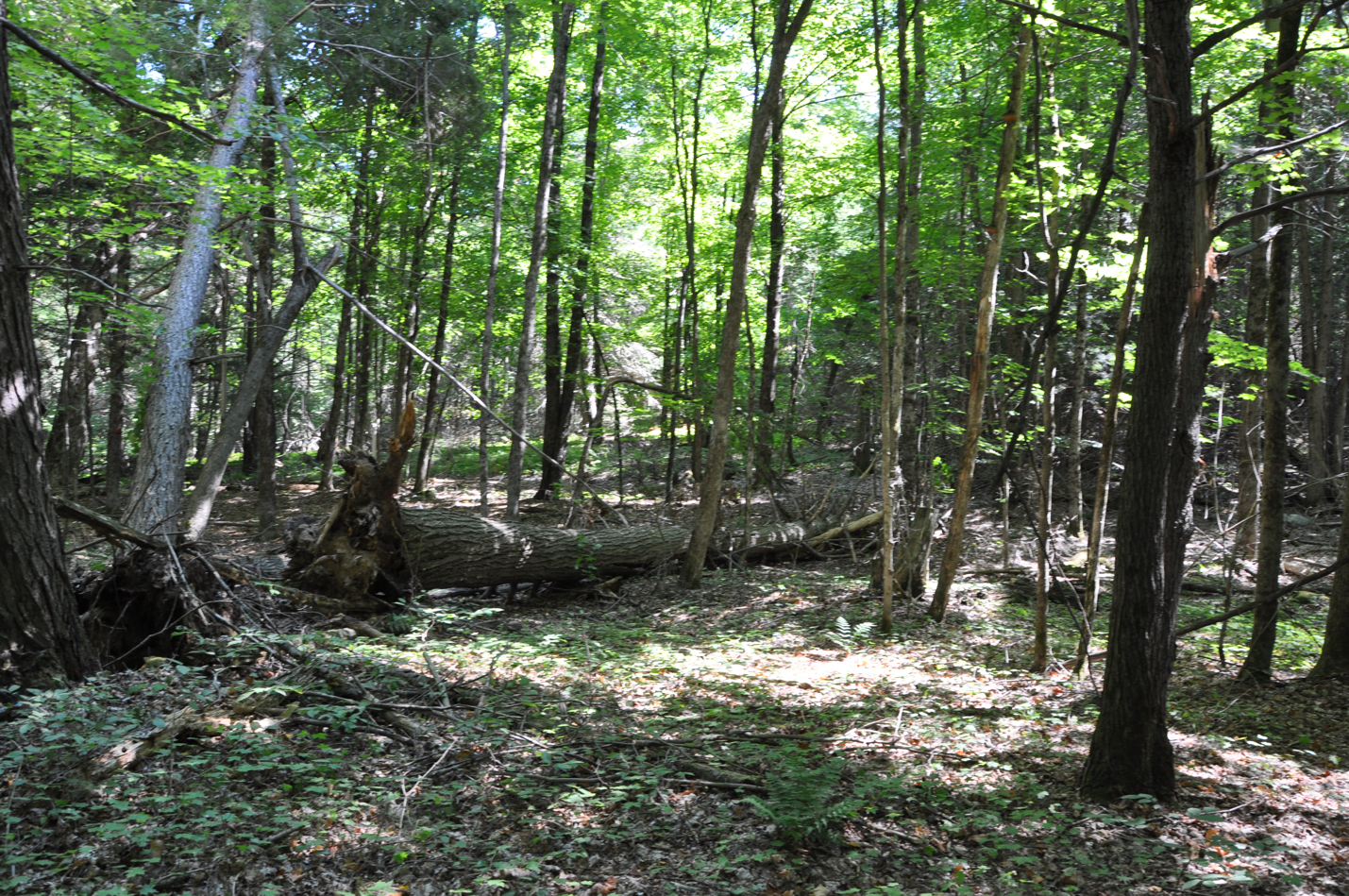
 After a windstorm, this tree will become firewood.
Here is another candidate. This was one big maple. Splitting it was hard work, but worth it, because it split nicely.


Below is the harvester, chainsaw roaring, clearing small stuff.


He is well equipped. This is an articulated claw used, as you see, to pick up whole logs.


The red item on the back of the tractor is a winch, used to haul logs out of the bush.


Logs cut up and split, ready to stack in an open area to dry.


Drying.


When the split wood is thoroughly dry, it is moved in stages from the long pile to the ready pile by the "wood door" near the furnace inside. Here is the chain gang moving and stacking.


Just for scale, and because she was so cute. And so sure-footed.


Nostalgia

  July 1967 This photo was my father’s favourite. It is of my mother in their backyard under a willow tree, with my daughter; her age was ab...